Strength first. Control first. Progress with purpose.
The NeuroRebuild exercise framework combines strength, mobility, coordination, balance and conditioning with simple adaptations for different starting points.
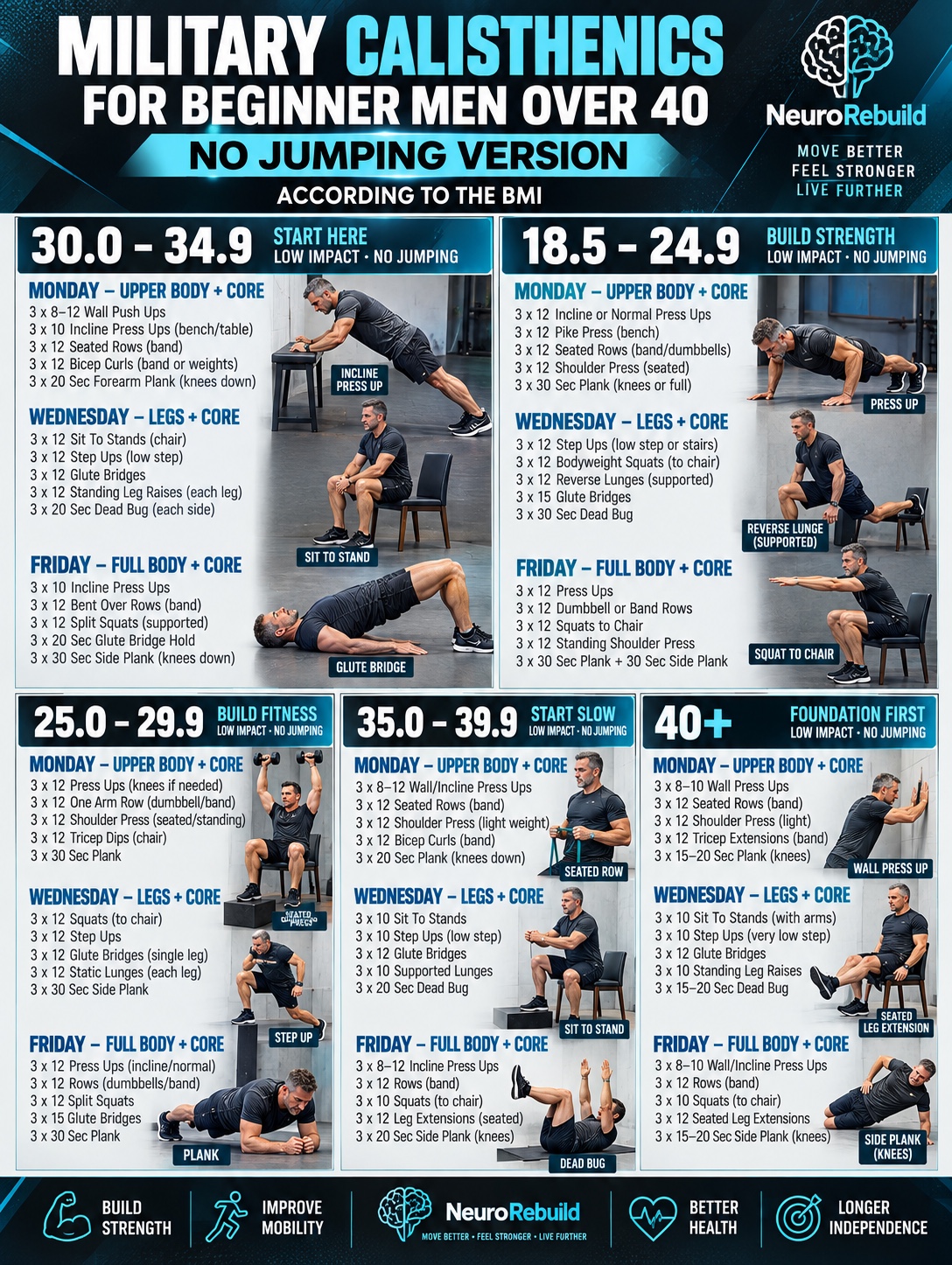
Low-impact, no-jumping example
Use a stable chair or wall as needed. The exact volume should be adjusted to the individual.
Upper Body + Core
Wall or incline press-ups · band rows · seated shoulder press · biceps curls · supported core work.
Legs + Core
Sit-to-stands · low step-ups · glute bridges · supported split stance · dead bug variations.
Full Body
Incline press-ups · rows · chair squats · supported leg work · side plank or seated core variation.
Choose a stable starting position
Chair, wall, bench or floor — whichever provides the appropriate level of support.
Own the movement
Prioritise controlled repetitions and good breathing over speed.
Build consistency
Repeat manageable sessions before increasing difficulty.
Progress one variable
Increase repetitions, range, resistance, balance demand or complexity — not everything at once.
Release → Mobilise → Activate → Strengthen → Stabilise → Integrate
This six-stage sequence is taken from the NeuroRebuild Stretching & Strength Programme and gives the exercise library a clear progression.
Release
Reduce unnecessary tension and prepare the body.
Mobilise
Move joints through controlled, comfortable ranges.
Activate
Wake up the muscles responsible for control and stability.
Strengthen
Build strength through the available range of movement.
Stabilise
Develop balance, control and resistance to unwanted movement.
Integrate
Transfer improvements into useful everyday movement.
A simple daily movement routine
| Exercise | Duration / Reps |
|---|---|
| Hip flexor stretch | 45 sec/side |
| Figure-4 glute stretch | 45 sec/side |
| Supine hamstring stretch | 45 sec/side |
| Wall calf stretch | 45 sec/side |
| Knee-to-wall ankle mobilisation | 10–15/side |
| Adductor rock-back | 10–12/side |
| Open-book rotation | 8–10/side |
| Doorway chest stretch | 30 sec/side |
| Kneeling lat stretch | 30–45 sec/side |
| Gentle breathing | 1–2 min |
5-Minute Dynamic Warm-Up
Marching · arm circles · hip circles · ankle circles · cat-cow · sit-to-stand · supported calf raises · thoracic rotations.
Progression Principle
Range of motion → Control → Strength in that range → Balance → Functional movement.